|
Psychological
and legal evidence of
the existence
of ritual abuse is substantial and rapidly growingh.
Satanism
and
Ritual
Abuse Archive, by Diana Napolis, M.A., Copyright 2000 and 2007
The
following
cases
describe legal proceedings held in Juvenile, Family, Civil and Criminal
Courts around the world where there have been allegations of Satanism
or the use of Ritual to abuse others.
Any
religion or
organization can be used as a front to hide ritual abuse activity,
including Christianity, Buddhism, Shamanism, Hinduism, Masonry,
Mormonism, Pagan and Satanic religions; however, not all Satanists
commit crimes and not all occultism is Satanism. It is imperative that
investigators and professionals familiarize themselves with
cross-cultural belief systems so as not to target any particular group.
This
document will
have regular updates; this present version is current as of July 10,
2007. It is recommended that this archive be used as a resource only
and original documents be obtained from Lexis/Nexus or Westlaw with the
assistance of an attorney. If the reader does not have access to legal
searches, or if there are any updates to these cases, contact the
author at: 6977
Navajo Rd.
PMB 114, San Diego, California 92119-1503
Warning:
Some of
the following
cases depict graphic, violent activity.
The psychological
literature supports
that ritualistic
abuse is a real phenomenon that must be correctly assessed and treated
(Belitz, & Schacht, 1992; Bernet & chang, 1997; Bloom,
1994;
Boat,
1991; Boyd, 1991; Brown, 1994; Clark, 1994; Clay, 1996; Coleman, 1994;
Cook, 1991; Coons, 1997; Cozolino, 1989, 1990; deMause, 1994; Driscoll
& Wright, 1991; Edwards, 1990; Ehrensaft, 1992; Faller, 1994;
Feldman,
1993; Finkelhor, Williams, & Burns, 1988; Fraser, 1990, 1997a,
1997b;
Friesen, 1991, 1992, 1993; Gonzalez, Waterman, Kelly, McCord, &
Oliveri,
1993;
Golston, 1993; Gonzalez, Waterman, Kelly,
McCord,
& Oliveri, 1993; Goodman, Quas, Bottoms, Qin, Shaver, Orcutt,
&
Shapiro, 1997; Goodwin, 1994; Gould, 1992, 1995; Gould &
Cozolino,
1992; Gould & Graham-Costain, 1994; Gould & Neswald,
1992;
Greaves,
1992; Hammond, 1992; Harvey, 1993; Hill & Goodwin, 1989;
Hudson,
1990,
1991; Ireland & Ireland, 1994; Jones, 1991; Jonker &
Jonker-Bakker,
1991; Jonker & Jonker-Bakker, I., 1997; Kelley, 1989; King
&
Yorker,
1996; Kinscherff & Barnum, 1992; Lawrence, Cozolino, &
Foy,
1995;
Leavitt, 1994; Leavitt & Labott, 1998; Lockwood, 1993; Lloyd,
1992;
Mandell & Schiff, 1993; Mangen, 1992; Mayer, 1991; McCulley,
1994;
McFarland & Lockerbie, 1994; Moriarty, 1991, 1992; Neswald
&
Gould,
1993; Neswald, Gould, & Graham-Costain, 1991; Noblitt, 1995;
Noblitt,
& Perskin, 2000; Nurcombe & Unutzer, 1991; Oksana,
1994, 2001;
Rockwell, 1994, 1995; Rose, 1996; Ross, 1995; Ryder, 1992; Sachs, 1990;
Sakheim & Devine, 1992b; Sakheim, 1996; Scott, 2001; Sinason,
1994;
Smith, C. 1998; Smith, M. 1993; Smith & Pazder, 1981; Snow
&
Sorenson,
1990; Stafford, 1993; Stratford, 1993; Summit, 1994; Tamarkin, 1994a,
1994b;
Tate, 1991; Uherek, 1991; Valente, 1992; Waterman, Kelly, Olivieri,
McCord,
1993; Weir & Wheatcroft, 1995; Wong & McKeen, 1990;
Woodsum, 1998; Young, 1992;
Young,
1993; Young, Sachs, Braun, & Watkins, 1991; Young &
Young,
1997.
A recent review of
the empirical
evidence of ritual
abuse is included in a book by Noblitt and Perskin
(Cult and Ritual
Abuse,
2000, Chapter 6). One national survey of 2709 clinical psychologists
showed
that 30% claimed to have seen at least one case of "ritualistic
or
religion-based
abuse" and 93% of these psychologists believed the harm
actually
occurred
(Goodman, Qin, Bottoms, & Shaver, 1994).
Noblitt reports that,
"In
a survey of the membership of the International Society for the Study
of
Multiple Personality and Dissociation, [Nancy] Perry concluded that 88%
of 1185 respondents reported belief in ritual abuse, involving mind
control
and programming". (Paper presented at the 40th Annual Meeting
of
the
American
Society of Clinical Hypnosis, Fort Worth, Texas, March 18, 1998,
adapted from Noblitt, 1998;
Accessing
Dissociated Mental States, referring to Perrys findings published in
the
International Society for the Study of Multiple Personality and
Dissociation
Newsletter, 1992, p. 4).
The American Psychiatric Press published a
text
in 1997 explaining the importance of correct assessment and treatment
of
ritualistic abuse survivors (The Dilemma of Ritual Abuse: Cautions and
Guides for Therapists, edited by Fraser).
books
on August 8, 2003 found 36 books on treating survivors, self-help for
survivors,
and supporting the existence of ritual abuse.
This list is posted on
this
web-site on the page, "Books and videotapes on ritual abuse (including
Brice Taylor Trust Materials)".
September 4, 2002, United States Marshals
in
Oregon arrested Russell Smith, accused child rapist and self-proclaimed
Satanist. He was wanted by the Prince William County Police Department
in Virginia for rape and sodomy of a child. According to authorities,
Smith
convinced a young girl to become involved in satanic rituals, and part
of those rituals involved having sex with her
(http://www2.amw.com/amw.html).
Police found in his basement a goats skull with a pentagram drawn on
it,
black robes, girls' underwear, and ceremonial candles. His license
plate
read 100P666". Smith was profiled on "America's Most Wanted on 8-31-02.
The broadcast led to his arrest. Due to these allegations, the Satanic
group he founded as Rev. Sorath, Order of Perdition, has excommunicated
him (Washington Post, 8-27-02, p. B03, 8-30-02, p. B01).
Numerous court decisions (criminal, family,
juvenile,
and civil) have been based on findings of ritual abuse. One list is
archived,
periodically updated, and published on the world-wide web by "Karen
Curio
Jones" (Problems
for Victims of Ritual Abuse in San Diego, California).
In August, 2002, 65 cases were presented in this archive.
For example,
on February 27, 1999, the Honorable Warren K. Urbom, Senior United
States
District Judge, Omaha, Nebraska, awarded a million dollar civil
judgement
to Paul
Bonacci
based on sexual abuse
(including
pornography and orgies) and false imprisonment of Bonacci as a child,
in
the infamous Franklin ritual cult/sex/drug ring case. This case is
discussed
in depth in John De Camps 1994 book, "The Franklin Cover-Up", and on
the
internet at: http://www.iahf.com/other/20001202a.html.
The post-trial geological survey under the
McMartin
preschool's foundation yielded convincing corroboration of the
children's
reports of being taken through underground tunnels ("The Dark Tunnels
of
McMartin", Summit, R.C., The
Dark Tunnels)
A good deal more information on ritual
abuse
would be available if it were not for the secrecy preserved by the
underground
groups that commit such abuse, the profound dissociative responses and
fear of disclosure among its victims (Fraser; 1997b; Young &
Young,
1997), and the sophisticated use of mind control by some abuser groups.
Proponents of the position that memories of ritual abuse are false or
grossly
exaggerated, e.g., the False Memory Syndrome Foundation, claim
therapists
lead clients to believe they were ritually abused and have had
considerable
influence on the media and a considerable presence in the courts. Thus,
psychotherapists treating victims of these abuses are often guarded
about
divulging this clinical data, sharing their findings with their
colleagues,
or worse, they discount the reports of their clients, resulting in
further
suppression of this information (Brown, Scheflin, &
Hammond,
1998;
Coons, 1997; Whitfield, Silberg, & Fink, 2002; Young &
Young
1997).
Ritual
Abuse:
International Clinical Perspectives
The
Los Angeles campus of the California School of Professional Psychology
of Alliant International University is sponsoring a one-day workshop
entitled
Ritual
Abuse: International Clinical
Perspectives
Friday,
October 19, 2012, 9am to 4pm, Los
Angeles California
Attendance
will be $30 per
person, payable at the door or on the website for Alliant International
University (this option will be available in the near future). CEU
accreditation is pending. You are welcome to cross-post to other
interested individuals and lists. The date of the workshop is Friday,
October 19, 2012, from 9 am until 4 pm at the Los Angeles campus
located at 1000 N Fremont, Alhambra, CA. Lunch and parking fees are not
included.
Ritual
Abuse: International Clinical
Perspectives
Introduction: This day-long
workshop provides training for mental health practitioners on the topic
of ritual abuse. The presenters are all clinicians with clinical and
forensic experience as well as previous and ongoing scholarly work in
this area.
Valerie
Sinason, PhD,
Clinic for Dissociative Studies, London, United Kingdom:
When Confidential Work is
in the Public Eye: The Socio-Political Problems of Psychoanalytically
Oriented Work with Ritual Abuse Survivors.�
Abstract: Whilst a Consultant
Psychotherapist at the Tavistock Clinic, the
largest
National Health Service psychoanalytic psychotherapy training and
treatment centre in the UK, Sinason was asked to supervise the therapy
of a traumatised woman with intellectual disability in Sweden. It
emerged she had been tortured by a group of staff who involved her in
abusive activities in cemeteries, churches and other places. In
discussing this work in the UK Sinason received referrals at the
Tavistock Clinic of white middle class professional women who stated
they were victims of ritual abuse. At this point in 1990 in the UK,
ritual abuse was seen as something that had happened in the USA alone.
Together with a Consultant psychiatrist and psychoanalyst Dr Robert
Hale, who was Chairman of the Portman Clinic, the Forensic part of the
Tavistock trust, Department of Health funding was sought to look into
the lack of adequate police and health service responses. A four year
research project was undertaken which was significant, not just in
itself, but in the social and media responses to such extreme trauma. A
significant minority of the research group turned out to have
dissociative identity disorder (DID), something there had been no
training in at that point. This presentation looks at the secondary
traumatisation to clinicians and the wider population and the impact on
clinicians of working in an area impacted on by media fears.
About
the Speaker: She is
currently Director of the Clinic for Dissociative Studies,
London. Dr.
Sinason is an Honorary Consultant Psychotherapist to
the Cape Town
Child Guidance Clinic, University of Cape
Town Psychology Department
and President of the Institute for Psychotherapy and Disability.
She is
a widely published and anthologized Poet, with two full-length
collections, the last being Night-Shift (1996), Karnac Books. She has
written extensively on psychotherapy, disability and abuse with over 70
published peer-reviewed papers, chapters and books. She was a Consultant
Child Psychotherapist at the Tavistock Clinic where
she
worked from 1987 until July 1999 and was a Consultant Psychotherapist
at both the Anna Freud and Portman Clinics from 1994-7. She was Consultant
Research Psychotherapist/Psychoanalyst at St Georges'
Hospital Medical School, University of London,
Psychiatry of Disability
Dept. from 1995-2007.
She
specializes in
disability, trauma and abuse and is regularly used as an expert in
court cases. Among her recent books are: Attachment Trauma and
Multiplicity (Sinason, 2011) and Treating Survivors of Satanist Abuse
(Sinason, 1994).
Adah
Sachs, MA, London, United Kingdom:
Infanticidal Attachment:
the
Pathway from RA into DID
Abstract: The damage of
ritual abuse (RA) goes far
beyond the agony and
terror that it produces in any individual. Most notably, it appears to
affect further generations; and, counterintuitively, the involvement of
each individual with the abusive group can be very hard to stop. The
'hold' that such groups have on individuals have been a source of
confusion and frustration to survivors and therapists alike. This talk
will propose that attachment, our
most basic safety and survival
instinct, can also become a Trojan Horse through which the worst damage
may invade mind and body. This newly suggested
type of attachment can
fracture the Self, produce dissociative disorders and leave a person
unable to maintain any safety. As this is precisely the opposite of
what attachment is meant to do, such presentation should be seen as a corruption of the attachment
instinct, or an attachment disorder. The
talk will describe in detail how this process occurs, show the cyclical
relationship between RA and dissociative disorders and point to the
places where the vicious cycle may be interrupted.
About the Speaker: Adah Sachs
is a UKCP Registered Psychoanalytic
Psychotherapist, a member of the Bowlby
Centre and Consultant
Psychotherapist at the Clinic for Dissociative
Studies, London. She is
also a Visiting Lecturer on trauma and dissociation
and a Training
Supervisor on the MA Psychotherapy Programmes at the Centre for Child
Mental Health and at the Bowlby Centre. She has
authored numerous
international presentations and publications on the topics of
attachment, dissociation, and abuse. Among her scholarly contributions
is her book, Forensic Aspects of Dissociative
Identity Disorder (Sachs
and Galton, 2008).
Alison
Miller, PhD, Victoria, BC, Canada:
Dialogue with the
Higher-Ups�
Abstract: Organized
mind-controlling abuser groups deliberately create
dissociative disorders in the children they abuse, and structure their
victims' personality systems in a hierarchical manner. Each
deliberately created alter personality has a job, and a boss, and is
trained for unthinking obedience and loyalty to the perpetrator group
or "family." High-up alters enforce the rules by ordering and
administering punishments to those who disobey, for example by
disclosing secrets. Successful therapy involves reaching out to these
higher-ups and engaging them in dialogue which leads them to question
what they have been taught. An actual dialogue (by e-mail) with the
higher-up alters of a survivor of ritual abuse and mind control will be
used to illustrate how to engage in such dialogue, important topics to
address, and the therapeutic changes effected by such dialogue.
About
the Speaker: Dr. Miller is presently in private
practice in
clinical psychology, specializing in abuse survivors, persons with
dissociative disorders, and in particular survivors of organized abuse
including ritual abuse and mind control. She also
addresses child and
family problems, and parenting issues.
Dr. Miller coordinated the Child
and Youth Program at the Victoria Mental Health Centre
for many years,
and is the originator and Director of Living in
Families Effectively
(LIFE) Seminars, educational family living seminars
presented as
courses, videotapes, printed materials, and part of the Good Medicine
program for aboriginal nations. She has made many presentations about
dissociative disorders and organized child abuse, and has published articles
on these topics. Her most recent publication is Healing the
Unimaginable: Treating Ritual Abuse and Mind Control published in
London by Karnac Books (Miller, 2012).
Randy
Noblitt, PhD,
Alliant International University, Los Angeles, USA:
Accessing Dissociated Mental States
Abstract: Ritual abuse
can be conceptualized as extremely painful or
humiliating procedures that are inflicted to train victims to respond
with trance, amnesia, and dissociation of identity. Why do perpetrators
engage in these abuses? This kind of perpetration creates a sense of
immense power and allows predators to engage in bizarre sexual abuses
that the victims are unable to resist or report because of their
incapacitating experience of dissociation of consciousness, memory and
identity caused by the trauma. In the case of Satanic ritual abuse the
ceremonial trauma results in what some call multiple personalities,
something that many authors have noted to be similar or identical in
appearance to spirit or demon possession. The survivors of ritual abuse
are trained to react with dissociative responses to specific triggering
stimuli. This workshop teaches psychotherapists how to identify clients
who are trigger responsive and how to work in a productive manner to
identify the component parts and mechanisms of their dissociative
systems in support of recovery. Specific techniques for clinical use
will be demonstrated.
About
the Speaker: Randy Noblitt is Professor of Clinical Psychology at
the Los Angeles campus of the California School of Professional
Psychology at Alliant International University. Dr. Noblitt developed a
year-long elective Trauma & Dissociation for the Clinical PsyD
Program. He is the author with Pamela Perskin of Cult
and Ritual Abuse:
Its History, Anthropology, and Recent Discovery in Contemporary America
(Noblitt & Perskin, 2000) and together they edited Ritual Abuse
in
the Twenty-First Century.(Noblitt & Noblitt, 2008).
|
Bibliography
American
Psychiatric
Association
(1994). Diagnostic and statistical manual of mental disorders (4th
ed.).
Washington D.C.: Author.
Belitz, J., and Schacht,
A.
(1992). Satanism as a response to abuse:
The dynamics and treatment of
satanic
involvement
in male youths. Adolescence, 27, 855-872.
Bernet W, Chang DK.
(1997).
The differential diagnosis of ritual abuse allegations. Journal of
Forensic
Science, 42(1), 32-38.
Bloom, S.L. (1994) .
Hearing
the survivors voice: Sundering the wall of denial. Journal of
Psychohistory,
21(4), 461-477.
Boat, B.W. (1991).
Caregivers
as surrogate therapists in treatment of a ritualistically abused child.
In W.N. Friedrich (Ed.) , Casebook of sexual abuse treatment., (pp.
1-26).
New York: Norton.
Boyd, A. (1991).
Blasphemous
rumors: Is Satanic ritual abuse fact or fantasy? An investigation.
London:
HarperCollins
Brown, D. (1994).
Satanic
ritual abuse: A therapist's handbook. Denver, CO: Blue Moon Press.
Brown, D., Scheflin,
A.W.,
& Hammond, D.C. (1998). Memory, trauma treatment, and the law:
An
essential
reference on memory for clinicians, researchers, attorneys, and judges.
New York: Norton.
Carlson, E.B., Putnam,
F.W.,
Ross, C.A., Torem, M., Coons, P., Dill, D.L., Loewenstein, R.J.,
&
Braun, B.G. (1993). Validity of the Dissociative Experiences Scale in
screening
for multiple personality disorder: A multicenter study. American
Journal
of Psychiatry, 150(7), 1030-1036.
Chu, J.A., Frey, L.M.,
Ganzel,
B.L., & Matthews, J.A. (1999). Memories of childhood abuse:
Dissociation,
amnesia, and corroboration. American Journal of Psychiatry, 156(5),
749-755.
Clark, C.M. (1994),
Clinical
assessment of adolescents involved in Satanism. Adolescence, Summer,
XXIV
(114), 461-468.
Clay, C. (1996). More
Than
A Survivor. University of Saskatchewan Press.
Coleman, J. (1994).
Presenting
features in adult victims of Satanist ritual abuse. Child Abuse Review,
3: 83-92.
Cook, C. (1991).
Understanding
ritual Abuse: A study of thirty-three ritual abuse survivors. Treating
Abuse Today, 1(4), 14-19.
Coons, P.M. (1997).
Satanic
ritual abuse: First research and therapeutic implications. In G.A.
Fraser
(Ed.), The dilemma of ritual abuse: Cautions and guides for therapists
(pp. 105-117). Washington, DC: American Psychiatric Press.
Cozolino, L. J. (1989).
The
ritual abuse of children: Implications for clinical practice and
research.
The Journal of Sex Research, 26 (1), 131-138.
Cozolino, L. J. (1990)
Ritualistic
child abuse, psychopathology, and evil. Journal of Psychology and
Theology,
18 (3), 218-227.
De Mause (1994). Why
cults
terrorize and kill children. The Journal of Psychohistory, 21(4),
505-518.
Draijer, N. &
Langeland,
W. (1999). Childhood trauma and perceived parental dysfunction in the
etiology
of dissociative symptoms in psychiatric in-patients. American Journal
of
Psychiatry, 156(3), 379-385.
Driscoll, L. N. &
Wright,
C. (1991). Survivors of childhood ritual abuse: Multi-generational
Satanic
cult involvement. Treating Abuse Today, 1(4), 5--13.
Edwards, L. M. (1990).
Differentiating
between ritual assault and sexual abuse. Journal of Child and Youth
Care,
6(4), 67-89.
Ehrensaft, D. (1992).
Preschool
child sex abuse: The aftermath of the Presidio case. The American
Journal
of Orthopsychiatry, 62(2), 234-244.
Emerson, S., &
Syron,
Y. (1995). Adolescent Satanism: Rebellion masquerading as religion.
Counseling
& Values, 39, 145-159.
Evers-Szostak, M. &
Sanders,
S. (1992). The Children's Perceptual Alteration Scale (CPAS): A measure
of children's dissociation. Dissociation, 2 (June), 91-98.
Fagan, J. & McMahon,
P.P.
(1984). Incipient multiple personality in children: Four cases. The
Journal
of Nervous and Mental Disease, 172(1), 26-36.
Faller, K.C. (1994,
Spring).
Ritual abuse: A review of research. APSAC Advisor, 7(1), pp. 1,
19-27.
Feldman, G.C. (1993).
Lessons
in evil, lessons from the light: A true story of Satanic abuse and
spiritual
healing. New York: Crown Publishers.
Fewster, G. (1990). In
the
shadow of Satan: The ritual abuse of children. Journal of Child and
Youth
Care Special Issue. Calgary: University of Calgary Press:
Calgary
Finkelhor, D., Williams,
L.
M., & Burns, N. (1988). Nursery Crimes. Newbury Park, CA:
Sage.
Fraser G. A. (1990).
Satanic
Ritual Abuse: A cause of multiple personality disorder. Journal of
Child
and Youth Care, Special Issue, 55-65.
Fraser, G.A. (1997a).
The
dilemma of ritual abuse: Cautions and guides for therapists.
Washington,
D.C.: American Psychiatric Press.
Fraser, G.A. (1997b).
Visions
of memories: A patient's visual representation of ritual abuse
ceremonies.
In G.A.
Fraser (Ed.), The
dilemma
of ritual abuse: Cautions and guides for therapists (pp. 183-196).
Washington,
DC: American Psychiatric Press.
Friesen, J. G. (1991).
Uncovering
the Mystery of MPD. San Bernadino, California: Here's Life
Publishing.
Friesen, J. G. (1992).
Ego-Dystonic
or Ego-Alien: Alternate Personality or Evil Spirit? Journal of
Psychology
and Theology. 20(3), 197-200.
Friesen, J. G. (1993).
More
than Survivors: Conversations with Multiple Personality Clients. San
Bernadino,
California: Here's Life Publishing.
Golston, J. (1993). Ritual
abuse: Raising hell in psychotherapy: Creation of cruelty: The
political
military and multigenerational training of torturers: Violent
initiation
and the role of traumatic dissociation. Treating
Abuse Today, 3(6),
12-19.
Gonzalez, L.S.,
Waterman,
J., Kelly, R.J., McCord, J., & Oliveri, M.K. (1993). Children's
patterns
of disclosures and recantations of sexual and ritualistic allegations
in
psychotherapy. Child Abuse and Neglect, 17, 281-289.
Goodman, G.S., Qin, J.,
Bottoms,
B.L., & Shaver (1994). Characteristics and sources of
allegations
of
ritualistic child abuse: Final report to the National Center on Child
Abuse
and Neglect. [Unpublished manuscript].
Goodman, G. S., Quas, J.
A.,
Bottoms, B. L., Qin, J., Shaver, P. R., Orcutt, H., & Shapiro,
C.
(1997).
Children's religious knowledge: Implications for understanding satanic
ritual abuse allegations. Child Abuse and Neglect, 21(11),
1111-1130.
Goodwin, J.M. (1994).
Credibility
problems in sadistic abuse. The Journal of Psychohistory, 21(4),
479-496.
Gould, C. (1992).
Diagnosis
and treatment of ritually abused children. In D.K. Sakheim &
S.E.
Devine
(Eds.), Out of darkness: Exploring Satanism and ritual abuse (pp.
207-248).
New York: Lexington Books.
Gould, C. (1995).
Denying
ritual abuse of children. Journal of Psychohistory, 22(3),
329-339.
Gould, C., &
Cozolino,
L. (1992). Ritual abuse, multiplicity, and mind-control. Journal of
Psychology
and Theology. 20(3): 194-196.
Gould, C. &
Graham-Costain,
V. (1994). Play therapy with ritually abused children. Treating Abuse
Today,
4(2), 4-1; 4(3), 14-19.
Gould, C. & Neswald,
D.
(1992). Basic treatment and program neutralization strategies for adult
MPD survivors of satanic ritual abuse. Treating Abuse Today, 2(3),
5--10.
Greaves, G. B. (1992).
Alternative
hypotheses regarding claims of satanic cult activity. A critical
analysis.
In D. K. Sakheim, & S. F. Devine, (Eds.), Out of Darkness:
Exploring
Satanism and Ritual Abuse. (pp. 45-72). New York: Lexington
Books.
Hammond,
D. C. (1992).
Hypnosis
in MPD: Ritual abuse (also known as The
Greenbaum speech),
Fourth
Annual
Eastern Regional Conference on Abuse and Multiple Personality.
Downloaded
on 2-21-2003.
Harvey, S. (1993). Ann:
Dynamic
play therapy with ritual abuse. In T. Kottman & C. Schaefer, C.
(Eds.).
Play therapy in action: A casebook for practitioners (pp. 371-415).
Northvale,
New Jersey: Aronson..
Hassan, S. (1990).
Combating
cult mind control. Rochester, VT: Park Street Press.
Hassan, S. (2000).
Releasing
the bonds: Empowering people to think for themselves. Danbury, CT :
Aitan
Publishing.
Hersha, L., Hersha, C.,
Griffis,
D., & Schwarz, T. (2001). Secret weapons: Two sisters
terrifying
true
story of sex, spies, and sabotage. Far Hills, New Jersey: New
Horizon
Press.
Hill, S. & Goodwin,
J.
(1989) Satanism; Similarities between patient accounts and
pre-Inquisition
historical sources. Dissociation, 2(1), 39-44.
Hudson, P.S. (1990).
Ritual
child abuse: A survey of symptoms and allegations. Special issue: In
the
shadow of Satan: The ritual abuse of children. Journal of Child and
Youth
Care, 27-54.
Hudson, P.S. (1991).
Ritual
child abuse: discovery, diagnosis and treatment. Saratoga, CA: R
&
E Publishers.
Ireland, S.J. &
Ireland,
M..J. (1994). A case history of family and cult abuse. The Journal of
Psychohistory,
21(4), 417-428.
Johnson, M. (1994). Fear
and
power: From naivete to a believer in cult abuse. The Journal of
Psychohistory,
21(4), 435-441.
Jones, D.P.H. (1991).
Ritualism
and child sexual abuse. Child Abuse and Neglect, 15, 163-170.
Jonker, F. &
Jonker-Bakker,
P. (1991). Experiences with ritualistic child sexual abuse: A case
study
from the Netherlands. Child Abuse and Neglect, 15(3),
191-196.
Jonker, F;
Jonker-Bakker,
I. (1997). Effects of Ritual Abuse: The results of three surveys in the
Netherlands. Child Abuse & Neglect, 21(6) 541-556
Kelley, S.J. (1989).
Stress
responses of children to sexual abuse and ritualistic abuse in day-care
centers. Journal of Interpersonal Violence, 4(4), 501-513.
King, G. F.; Yorker, B.
(1996).
Case studies of children presenting with a history of ritualistic
abuse.
Journal of Child and Adolescent Psychiatric Nursing, 9(2),
pp.18-26.
Kinscherff, R. &
Barnum,
R (1992). Child forensic evaluation and claims of ritual abuse or
Satanic
cult activity: A critical analysis. In D.K. & S.E. Devine
(Eds.),
Out
of Darkness: Exploring Satanism and ritual abuse. 73-107. New York, NY:
Lexington Books.
Lawrence, K.J.,
Cozolino,
L., & Foy, D.W. (1995). Psychological sequelae in adult females
reporting
childhood ritualistic abuse. Child Abuse and Neglect, 19(8),
975-84.
Leavitt, F. (1994).
Clinical
correlates of alleged Satanic abuse and less controversial sexual
molestation.
Child Abuse and Neglect, 18(4), 387-392.
Leavitt F, & Labott,
S.
M.(1998). Revision of the Word Association Test for assessing
associations
of patients reporting Satanic ritual abuse in childhood. Journal of
Clinical
Psychology, 54(7), 933-943.
Lloyd, D. W. (1992).
Ritual
child abuse: Definitions and assumptions. Journal of Child Sexual
Abuse,
1(3), 1-14.
Lockwood, C. (1993)
Other
altars: Roots and realities of cultic and Satanic ritual abuse and
multiple
personality disorder. Minneapolis, MN: Compcare.
Lotto, D. (1994). On
witches
and witch hunts: Ritual and Satanic cult abuse. The Journal of
Psychohistory,
21(4), 373-396.
Luxenberg, T.,
Spinazzola,
J., &. van der Kolk, B. (2001). Complex trauma and Disorders of
Extreme
Stress (DESNOS): Diagnosis, part one: Assessment. Directions in
Psychiatry
(21), Downloaded on 8-24-2003: http://www.traumacenter.org/
Luxenberg, T.,
Spinazzola,
J., Hidalgo, J., Hunt, C., &. van der Kolk, B. (2001), Complex
trauma
and Disorders of Extreme Stress (DESNOS) Diagnosis, part two:
Treatment.
Directions in Psychiatry (21), Downloaded on 8-24-2003: http://www.traumacenter.org/
Macfarland, R.B.,&
Lockerbie,
G. (1994). Difficulties in treating ritually abused children. Journal
of
Psychohistory, 21(4), 429-434.
Mandell, H. E. &
Schiff,
M.(1993). Schizophrenia or terrifying reality? A supervisor's dilemma.
The Clinical Supervisor, 11(20, 127-133.
Mangen, R. (1992).
Psychological
testing and ritual abuse. In D.K. Sakheim & S.E. Devine (Eds.),
Out
of darkness: Exploring Satanism and ritual abuse (pp.
147-173).
New
York: Lexington.
Mayer, R.S. (1991).
Satan's
Children: Case Studies in Multiple Personality. New York:
Putnam.
McCulley, D. (1994).
Satanic
ritual abuse: A question of memory. Psychology and Theology, 22(3),
167-172.
Moriarty, A. R., (1991)
Adolescent
Satanic cult dabblers: A differential diagnosis. Journal of Mental
Health
Counseling, 13(3), pp. 393--404.
Moriarty, A. (1992) The
psychology
of adolescent Satanism: A guide for parents, counselors, clergy, and
teachers.
Westport, CT: Praeger Publishers/Greenwood.
Neswald, D., &
Gould,
C. (1993). Basic treatment and program neutralization strategies for
adult
MPD Survivors of Satanic ritual abuse. Treating Abuse Today, 4 (3),
14-19.
Neswald, D., Gould, C.,
&
Graham-Costain, V. (1991).Common programs observed in survivors of
Satanic
ritual abuse. The California Therapist, 3 (5), 47 50.
Noblitt, J.R. (1995).
Psychometric
measures of trauma among psychiatric patients reporting ritual abuse.
Psychological
Reports, 77(3), 743-747.
Noblitt,, J.R. &
Perskin,
P. (2000). Cult and ritual Abuse: Its history, anthropology, and recent
discovery in contemporary America; Revised edition. Westport, CT:
Praeger
Publishers.
Nurcombe, B &
Unutzer,
J (1991). The ritual abuse of children: clinical features and
diagnostic
reasoning. Journal of the American Academy of Child and Adolescent
Psychiatry,
30(2), 272-276.
Ogawa, J.R., Sroufe, A.,
Weinfield,
N.S., Carlson, E.A., & Egeland, B. (1997). Development and the
fragmented
self: Longitudinal study of dissociative symptomatology in a
nonclinical
sample. Development and Psychopathology, 9, 855-879.
Oksana, C. (1994,
revised
2001) Safe passage to healing: A guide for survivors of ritual abuse.
NY:
Harper Perennial.
Pelcovitz D, van der
Kolk
BA, Roth S, Mandel, F., Kaplan, S., & Resicket, P. (1997).
Development
of a criteria set and a structured interview for disorder of extreme
stress
(SIDES). Journal of Traumatic Stress,10(1):316.
Perlman, S. D. (1995). One
analyst's journey into darkness: Countertransference resistance to
recognizing
sexual abuse, ritual abuse, and multiple personality disorders.
Journal
of the American Academy of Psychoanalysis, 23(1), 137-51.
Peterson, G. (1991).
Children
coping with trauma: Diagnosis of "dissociation identity disorder".
Dissociation
Progress in the Dissociative Disorders, 4(3), 152-164.
Peterson, G. (1996).
Treatment
of early onset. In J.L. Spira & I.D. Yalom (Eds.). Treating
Dissociative
Identity Disorder (pp. 135-181). San Francisco: Josey-Bass.
Putnam, F.W. (1997).
Dissociation
in children and adolescents: A developmental perspective. New York:
Guilford
Press.
Putnam, F.W., Helmers,
K.,
Horowitz, L.A., & Trickett, P.K. (1995). Hypnotizability and
dissociativity
in sexually abused girls. Child Abuse and Neglect. 19(5),
645-655.
Pynoos, R.S., Steinberg,
A.M.,
& Goenjian, A. (1996). Traumatic stress in childhood and
adolescence:
Recent developments and current controversies. In B.A. van der Kolk,
A.C.
McFarlane, & L. Weisaeth (Eds.). Traumatic stress: The effects
of
overwhelming
experience on mind, body, and society (pp 331-358). New York: Guilford
Press.
Read, J., Perry, B.,
Moskowitz,
A. & Connolly, J. (2001). The contribution of early traumatic
events
to schizophrenia in some patients: A traumagenic neurodevelopmental
model.
Psychiatry: Interpersonal and Biological Processes,
64 (4).
Rockwell, R.B. (1994).
One
psychiatrists view of Satanic ritual abuse. The Journal of
Psychohistory,
21(4), 443-460.
Rose, E. (1996).
Reaching
for the Light: A Guide for Ritual Abuse Survivors and Their Therapists.
Cleveland: Pilgrim Press.
Ross,
C.A. (1989).
Multiple
personality disorder: Diagnosis, clinical features, and treatment. New
York: Wiley.
Ross, C.A. (1995).
Satanic
ritual abuse: Principles of treatment. Toronto: University of Toronto
Press.
Rutz, C. (2001). A
nation
betrayed: The chilling and true story of secret cold war experiments
performed
on our children and other innocent people. Grass Lake, MI: Fidelity
Publishing.
Ryder, D. (1992).
Breaking
the circle of Satanic ritual abuse: Recognizing and recovering from the
hidden trauma. Minneapolis, MN: CompCare Publishers.
Sachs, R.G. (1990). The
role
of sex and pregnancy in Satanic cults. Journal of Prenatal and
Perinatal
Psychology and Health, 5 (2), 105-114
Sakheim, D.K. (1996).
Clinical
aspects of sadistic ritual abuse. In L.K. Michelson & W.J. Ray
(Eds),
Handbook of dissociation: Theoretical, empirical, and clinical
perspectives,
(pp. 569-594). New York: Plenum Press.
Sakheim, D.K., &
Devine,
S.E. (Eds.) (1992). Out of darkness: Exploring Satanism and ritual
abuse.
New York: Lexington.
Scott, S. (2001). The
Politics
and Experience of Ritual Abuse: Beyond Disbelief. Philadelphia: Open
University
Press.
Sinason, V. (1994).
Treating
survivors of satanic abuse. London, and NY, NY: Routledge.
Smith, C. (1998). The
Magic
Castle. New York: St. Martin's Press.
Smith, M. (1993). Ritual
Abuse:
What it is, why it happens, how to help. San Francisco:
Harper.
Smith, M., & Pazder,
L.
(1981). Michelle Remembers. New York: Pocket Books.
Snow B. & Sorensen
(1990).
Ritualistic child abuse in a neighborhood setting. Journal of
Interpersonal
Violence, 5(4), 474-487.
Stafford, L. L. (1993).
Dissociation
and multiple personality disorder: A challenge for psychosocial nurses.
Journal of Psychosocial Nursing and Mental Health Services, 31(1),
15-20.
Stratford, L. (1993).
Satan's
Underground. Gretna, LA: Pelican Publishing.
Summit, R.C. (1994). The
dark
tunnels of McMartin. The Journal of Psychohistory, 21(4),
397-416.
Tamarkin, C. (1994a).
Investigative
Issues in Ritual Abuse Cases, Part I. Treating Abuse Today, 4 (4):
14-23.
Tamarkin, C. (1994b).
Investigative
Issues in Ritual Abuse Cases, Part II. Treating Abuse Today, 4 (5):
5-9.
Tate, T. (1991).
Children
for the devil: Ritual abuse and Satanic crime. London:
Methuen.
Uherek, A.M. (1991).
Treatment
of a ritually abused preschooler. In W.N. Friedrich (Ed.) Casebook of
sexual
abuse treatment. (pp. 70-92). New York: Norton.
Valente SM. (1992) The
challenge
of ritualistic child abuse. Journal of Child and Adolescent Psychiatric
Mental Health Nursing, 5(2):37-46.
van der Kolk,
B.A.,
McFarlane, A.C., & Weisaeth, L. (Eds.) (1996). Traumatic
stress:
The
effects of overwhelming experience on mind, body, and society. New
York:
Guilford.
van der Kolk B.A., Roth
S.,
Pelcovitz D., Mandel F. (1993). Complex PTSD: Results of the PTSD field
trial for DSM-IV. Washington, DC: American Psychiatric
Association.
Waterman, J.,
Kelly,
R.J.,
Olivieri, M.K., McCord, J. (1993). Beyond the playground walls: Sexual
abuse in preschools. New York: Guilford.
Weir, I.K. &
Wheatcroft,
M.S. (1995). Allegations of children's involvement in ritual sexual
abuse:
Clinical experience of 20 cases. Child abuse and Neglect, 19(4),
491-505.
Whitfield, C.L.,
Silberg,
J., & Fink, P.J. (Eds.) (2002). Misinformation concerning child
sexual
abuse and adult survivors. New York: Haworth Press.
Wong, B., & McKeen,
J.
(1990). A case of multiple life-threatening illnesses related to early
ritual abuse. Special Issue: In the shadow of Satan: The ritual abuse
of
children. Journal of Child and Youth Care, 1-26.
Woodsum, G.M. (1998).
The
Ultimate Challenge: A Revolutionary, Sane and Sensible Response to
Ritualistic
and Cult-Related Abuse. WY: Action Resources International
Young, W.C. (1992).
Recognition
and treatment of survivors reporting ritual abuse. In D.K. Sakheim
&
S.E. Devine (Eds.), Out of darkness: Exploring Satanism and ritual
abuse
(pp. 249-278). New York: Lexington.
Young, W. C. (1993).
Sadistic
ritual abuse. An overview in detection and management. Primary Care,
20(2),
447-58.
Young, W.C., Sachs,
R.G.,
Braun, B.G., & Watkins, R.T. (1991). Patients reporting ritual
abuse
in childhood: A clinical syndrome. Report of 37 cases. Child Abuse and
Neglect, 15, 181-189.
Young, W.C. & Young,
L.J.
(1997). Recognition and special treatment issues in patients reporting
childhood sadistic ritual abuse. In G.A. Fraser (Ed.), The dilemma of
ritual
abuse: Cautions and guides for therapists (pp. 65-103). Washington, DC:
American Psychiatric Press.
Summer
2008 has been a very exciting time for publications on ritual abuse and
mind control.
(Last
but not least:
Hot off the presses is ’s
article in Journal of
Aggression, Maltreatment & Trauma) Satanic
Ritual Abuse - SMART NEWS
- evidence with information on McMartin
Preschool case http://eassurvey.wordpress.com/2008/08/25/satanic-ritual-abuse-evidence/
or http://members.aol.com/smartnews/SRA_references_list.htm
mk-ultra
links - Torture-based,
Government-sponsored Mind Control Experimentation on Children
or http://members.aol.com/smartnews/mk-ultra.htm
Basic
Information on Dissociative Identity Disorder with
sections on Basic
Information on DID from the DSM-IV-TR,
The History of DID/MPD, Diagnosing DID, Responses to those that state
that DID is iatrogenic or a social construct, MPD/DID
connection
to severe abuse, Recent information and DID resources
May 2014
|

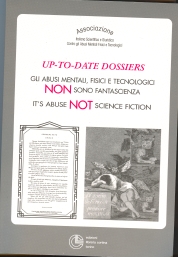

 Questa
rielaborazione del famoso Sonno della
ragione
di Goya
- ufficialmente
copyright - è resa molto
più
inquietante dell'originale per essere
utilizzata come copertina
del libro e spiegata
dal Disegnatore Andrzej
(Andrew)
Suda / This powerful,
more puzzling creative
modification
of the Goya's Sleep
of reason - marked by the official
Copyright - here is used as book
cover's
image,
and explained by the Designer:
Andrzej
(Andrew)
Suda: should
look just like many of the
events described by the victims: they exist,
are
bothersome,
and we don’t know exactly WHY they are there but
they are
there…
[come molti dei fatti descritti dalle vittime: essi
esistono, turbano e noi non riusciamo a conoscere esattamente
il
PERCHE'
ci siano, ma ci sono...] About the Book
This book not only documents the case of Andrzej Suda, it is also
filled with documentation from the worlds most influential documented
cases of psychological abuse, electronic harassment, organized stalking
and mind control. Some cases include Rauni Leena Kilde MD., Dr.
Reinhard Munzert, Kathy Sullivan, David
Larson,
and many others...
Please support the truth with the purchase of our book. This will
document many technologies and mind control weapons that have been kept
hidden from the mainstream public. Over 600 pages of action packed TRUTH!
Questa
rielaborazione del famoso Sonno della
ragione
di Goya
- ufficialmente
copyright - è resa molto
più
inquietante dell'originale per essere
utilizzata come copertina
del libro e spiegata
dal Disegnatore Andrzej
(Andrew)
Suda / This powerful,
more puzzling creative
modification
of the Goya's Sleep
of reason - marked by the official
Copyright - here is used as book
cover's
image,
and explained by the Designer:
Andrzej
(Andrew)
Suda: should
look just like many of the
events described by the victims: they exist,
are
bothersome,
and we don’t know exactly WHY they are there but
they are
there…
[come molti dei fatti descritti dalle vittime: essi
esistono, turbano e noi non riusciamo a conoscere esattamente
il
PERCHE'
ci siano, ma ci sono...] About the Book
This book not only documents the case of Andrzej Suda, it is also
filled with documentation from the worlds most influential documented
cases of psychological abuse, electronic harassment, organized stalking
and mind control. Some cases include Rauni Leena Kilde MD., Dr.
Reinhard Munzert, Kathy Sullivan, David
Larson,
and many others...
Please support the truth with the purchase of our book. This will
document many technologies and mind control weapons that have been kept
hidden from the mainstream public. Over 600 pages of action packed TRUTH!